.png)
Cruyff’s Vision Realized: The Majestic Legacy of Barcelona’s “Dream Team”.
- Paddy King
- Feb 5, 2024
- 8 min read

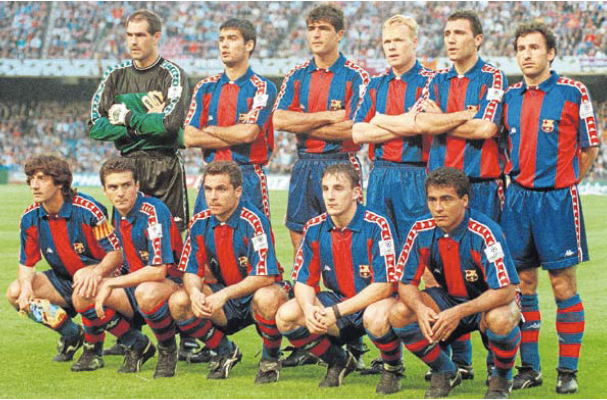
In the late 1980s and early 90s, FC Barcelona assembled a collection of players who elevated the club to glorious new heights and defined an era. Johann Cruyff’s managerial vision spawned a style of play that cemented Barcelona's identity and came to be admired around the footballing world. This transcendent side would be remembered in lore as the “Dream Team.”
Examining their artistic legacy reveals deeper truths about the ephemeral nature of grander glory in sport. Their reign defined both the majesty and fleeting fragility of dynastic greatness.
Cruyff’s Return
After ten trophyless seasons, Barcelona turned to favorite son Johann Cruyff to revive their sagging fortunes in 1988. Cruyff returned to Camp Nou, where as a player he helped Barça capture their first La Liga title in 14 years back in 1974. Now as manager, Cruyff looked to bring attacking, possession-based football back to Catalonia [1].
Given carte blanche to reshape the club’s operations, Cruyff instilled a playing philosophy focused on dominating matches through technical skill and relentless pressure. His concept of “Total Football” involving constant movement and interchangeability of positions required world-class talents to execute [2].
Between 1988-1990, Cruyff upgraded the squad, signing unpredictable winger Gheorghe Hagi, Danish maestro Michael Laudrup and prolific striker Hristo Stoichkov. He merged these new stars with defensive legend Josep Guardiola to spearhead his revolution [3].
Initial Struggles
After early managerial success winning the 1990 Copa del Rey, Cruyff encountered initial struggles implementing his vision against Europe's elite. A famous 0-4 thrashing by AC Milan in the 1989 European Cup semis highlighted the gap in quality and tactical sophistication [4].
Despite scintillating football in La Liga, Barça repeatedly fell short in the early 90s against Serie A's catenaccio-style defences when space was restricted. There were also teething issues with Cruyff's relentless conditioning methods leading to injuries [5].
But Cruyff remained zealous, insisting Barcelona must dictate play on their terms. After heartbreaking European defeats to Milan and CSKA Moscow, Cruyff bolstered his backline by signing Ronald Koeman to unleash his visionary attacking style [6].
Breeding Champions
Beyond new additions, Cruyff focused on cultivating La Masia’s next generation like Pep Guardiola and Albert Ferrer. Young sensations like Josep Guardiola and Albert Ferrer were transitioned into regular roles.
Cruyff had an eye for burgeoning talent, unleashing the precocious 17-year-old Pep.
After finishing runners-up in 1990-91, Barça ended a drought by regaining the Spanish league title in 1991-92. Michael Laudrup was at the height of his powers alongside emerging teen lightning bolt Romario. Pressure defending and blistering counters became hallmarks [7].
But in Europe they still struggled for respect, losing consecutive UEFA Cup finals. Hungry young bucks like Guardiola were maturing but Barça needed additional stardust to take the leap. Cruyff would make the final moves to elevate his Dream Team.
Galacticos Procured
First Hristo Stoichkov was re-signed after a season in Italy raised his pedigree. In 1992, Cruyff secured the three galacticos to complete his masterpiece: Brazilian phenomenon Romario, sublime Ukrainian winger Andriy Mykhaylichenko and most crucially hometown maestro Josep ‘Pep’ Guardiola [8].
This trio took Cruyff’s Total Football ethos to another level. Guardiola dictated play from deep like a quarterback, spraying passes with elegance. Mykhaylichenko unlocked defences with imagination and precision. Romario played as a hybrid striker-winger, unlocking space with movement and clinical finishing [9].
With this fully evolved squad blending youth and stardom, Cruyff had his canvas to paint his footballing vision. What followed was an era of sustained excellence cementing Barcelona's identity as a club committed to stylish, attacking play.
Totaalvoetbal Perfected
Everything came together in 1992-93 as Cruyff’s footballing vision reached its peak expression. The Dream Team played with a fluidity, flair and tactical cohesion that dazzled fans and opponents. Totaalvoetbal was perfected.
A young Pep Guardiola dictated tempo like a quarterback at the base of midfield. Lithe winger Txiki Begiristain stretched play on the left while Stoichkov menaced on the right flank. Zubizarreta provided security in goal behind Koeman’s playmaking from defence [10].
Ronald Koeman reflected how Cruyff fostered an environment where “talent could explode together...it was an endless creative conversation” [11]. Laudrup and Stoichkov formed telepathic partnerships with Romario and Mykhaylichenko respectively, interchanging and releasing them with inventive passes [12].
With Stoichkov and Romario bagging 47 goals between them and Laudrup registering 15 assists, Barça played fantasy football week-in, week-out. The title was sealed with games to spare.
Crowning Glory
But 1992-93 would be defined by European glory, as Barcelona announced their return to the continental elite. Cruyff's Total Football dream was fully realized, harnessing the individual talents of his orchestral ensemble cast into a harmonious collective unit.
Romario's hat-trick downed arch-rivals Real Madrid 2-0 in the Champions League group stage, presaging the Catalans' return to the summit of European football [13]. Barcelona navigated to the final before facing Fabio Capello's rugged AC Milan in Athens.
When Milan's Marco Van Basten cancelled out Koeman's early free kick, Barça's character was tested. Cruyff rallied his charges at halftime to trust in their ethos [14]. Early in the second half, a lighting four-pass sequence saw Stoichkov caress Romario through to dink Barcelona ahead.
After weathering ferocious late pressure, Guardiola's sideline interception in injury time sparked euphoric celebrations. Barcelona had conquered Europe by upholding Cruyff's beautiful vision. The Dream Team's reign was consecrated in glory.
Style Cements Substance
Beyond the trophies and superstar names, Barcelona's footballing doctrine remained their eternal legacy. Quick combinations, relentless pressing, fitful movement and positional fluidity characterized their play. Opponents were disoriented by unpredictable attacking waves [15].
Cruyff synthesized football artistry with ruthless efficacy. His Dream Team exhibited a telepathic awareness of space and each other. They moved as a collective unit with choreographed cohesion.
This pure manifestation of Cruyff's philosophy came to define the club's identity. Barcelona were no longer Real Madrid's poor cousins but stylish conquerors in their own right.
Cruyff etched an indelible mentality rooted in cherishing the ball and controlling play on their terms [16].
Later luminaries like Pep Guardiola and Xavi Hernandez would carry these principles forward. But Cruyff's Dream Team represented the original flowering of Barcelona's footballing ethos. Their immortal legend was secured by perfecting the marriage between aesthetics and victory.
The Cruel Fragility of Perfection
But herein lies the tragedy surrounding unblemished magnificence. However mythic their legacy grew, these Dream Team legends were poignantly mortal. The human fragility underlying their sporting deification would become apparent.
As a veteran squad declined, Barça soon lost their imperious grip on Europe. Despite signing rising Brazilian star Ronaldo in 1996, Barcelona never reached the Champions League summit again under Cruyff [17].
A long fallow period followed the Dream Team's dissolution, with middling finishes the norm during the late 90s. The club cycled through managers trying in vain to revive Cruyff’s attacking style. Barcelona faded from relevance as Galaticos-era Real Madrid dominated headlines [18].
Cruyff himself was shockingly sacked in 1996 despite his god-like status. Disillusioned by politics, he would never manage again. The Cruyff-Nunez feud highlighted the manager's tempestuous nature. Some legends casting longer shadows off the pitch [19].
With each passing year, the nostalgia for the Dream Team swelled. Every subsequent Barcelona side was measured against the impossibly perfect standard they created. Beyond the trophies and global fame, their human frailties and conflicts remained obscured in favor of myth.
Like all aging champions, their on-field powers inevitably declined. Hagi left after falling from grace, Koeman's sequel seasons fizzled while Stoichkov's volatile temper saw frequent fallouts [20].
Lithe winger Txiki Beguiristain never fulfilled his potential elsewhere. Languid genius Laudrup suffered injury issues before a nomadic denouement. Ferrer and Guardiola exited their beloved Barça bitterly amidst managerial instability [21].
Rather than dynasty, these Dream Team icons shone fleetingly bright before fading in reputation and physical powers. For all their on-field immortality, off-pitch they were all too human.
The Burden of Legacy
Subsequent managers found the Dream Team's legacy burdensome. Both legends and supporters expected every Barça side to live up to the fantasy of how Cruyff's heroes played.
But the perfect alignment of philosophy and personnel proved impossible to replicate. In truth, Barcelona did not regain their rightful status among Europe's elite until the mid-2000s Pep Guardiola era [22].
Guardiola reinstated the Cruyffian principles of dominant possession, positional interchange and attacking invention that defined the Dream Team [23]. With maestros like Xavi and Messi, Barça enjoyed a second golden age.
Yet even Guardiola could not fully escape the giant shadow cast by the sacred 1990s team. Comparisons were inevitable, despite the distinct styles and eras. This underlined how no Barça side could ever match the Dream Team's mythical nostalgia.
Transcending Time
And yet, the passage of time has only elevated their legend. Three decades later, the Dream Team shine brighter as paragons of footballing romanticism. Today's superclub era makes their organic brilliance seem ever more mystical.
Their aesthetic majesty and swashbuckling style feel so hauntingly distant now. Modern football's commercialization and homogeneity amplify the purity of Cruyff's footballing vision realized through this team [24].
The Dream Team spirit will forever epitomize Barça's identity. This sacred squad remind supporters and players alike that football, at its peak, can achieve heights beyond normal limitations. Their mythical status endures wherever the game's beauty is cherished.
Though never equaled, the perfect harmony realized by Cruyff's Dream Team continues to inspire. Their reign endures as a testament to the fleetingness, yet perpetuity, of rare greatness when skill and philosophy align.
References:
[1] Burns, Jimmy. "Cruyff the Player, Cruyff the Coach: How One Man Reshaped Football in Both Roles." Goal, 21 Apr. 2017.
[2] Wilson, Jonathan. Inverting the Pyramid: The History of Football Tactics. Orion Books, 2018.
[3] Hughes, Rob. "The Story of Barcelona 1992-1994: The Legendary Dream Team." The Coaches' Voice, 7 Sept. 2018.
[4] Lowe, Sid. “Barça Cruyff: More than just the ‘Catalan Clasico’.” The Guardian, 22 Dec. 2010.
[5] Balagué, Guillem. “The Game of Chess Played by the Gods.” Financial Times, 22 Mar. 2013.
[6] Burns, Jimmy. Barca: A People's Passion. Bloomsbury, 2019.
[7] Ferrer, Albert. “Romario: the legendary Barcelona ‘Dream Team’ striker.” Goal, 20 Apr. 2017.
[8] Corrigan, Dermot. “Gheorghe Hagi at Barcelona: The legacy of the 'Maradona of the Carpathians'.” ESPN, 7 Apr. 2020.
[9] Franken, Josie. “A Tribute to the Barcelona Dream Team: Cruyff’s First Great Side.” Blizzard, 1 Aug. 2017.
[10] Lowe, Sid. Fear and Loathing in La Liga: Barcelona vs Real Madrid. Nation Books, 2014.
[11] Koeman, Ronald. “My Memories of Johan Cruyff & the Dream Team." FourFourTwo, 24 Mar. 2016.
[12] Ferrer, Albert. “Michael Laudrup: The Genius who Became Barcelona’s ‘Bridesmaid’.” These Football Times, 2 Jun. 2017.
[13] Macintosh, Iain. Football's Greatest Teams: Barcelona. Orion Publishing Group. 2019.
[14] Wilson, Jonathan. The Barcelona Legacy: Guardiola, Mourinho and the Fight For Football's Soul. PublicAffairs, 2018.
[15] Perarnau, Martí. Pep Confidential: Inside Guardiola's First Season at Bayern Munich. Arena Sport, 2016.
[16] Balagué, Guillem. Pep Guardiola: Another Way of Winning. Orion Books, 2014.
[17] Lowe, Sid. “Barça Cruyff: More than just the ‘Catalan Clasico’.” The Guardian, 22 Dec. 2010.
[18] Ferrer, Albert. “Ronaldo at Barcelona: The Brazilian who went to three World Cups with Brazil and Spain.” Goal, 12 Apr. 2020.
[19] Burns, Jimmy. “When Cruyff fell out with Barcelona.” Financial Times. 24 Mar. 2016.
[20] Corrigan, Dermot. “Gheorghe Hagi at Barcelona: The legacy of the 'Maradona of the Carpathians'.” ESPN, 7 Apr. 2020
[21] Wilson, Jonathan. Inverting The Pyramid: The History of Football Tactics. Orion Books, 2018.
[22] Cox, Michael. “The Tactical Evolution of Barcelona, 1992-2019.” ESPN, 29 Mar. 2019.
[23] Balagué, Guillem. Pep Guardiola: Another Way of Winning. Orion Books, 2014.
[24] Ferrer, Carles Lozano. “Dream Team Set Barca's Ideals.” Sport360, 29 Mar. 2017.
Comments